Dermatologist-Approved Skincare That’s Actually Worth It

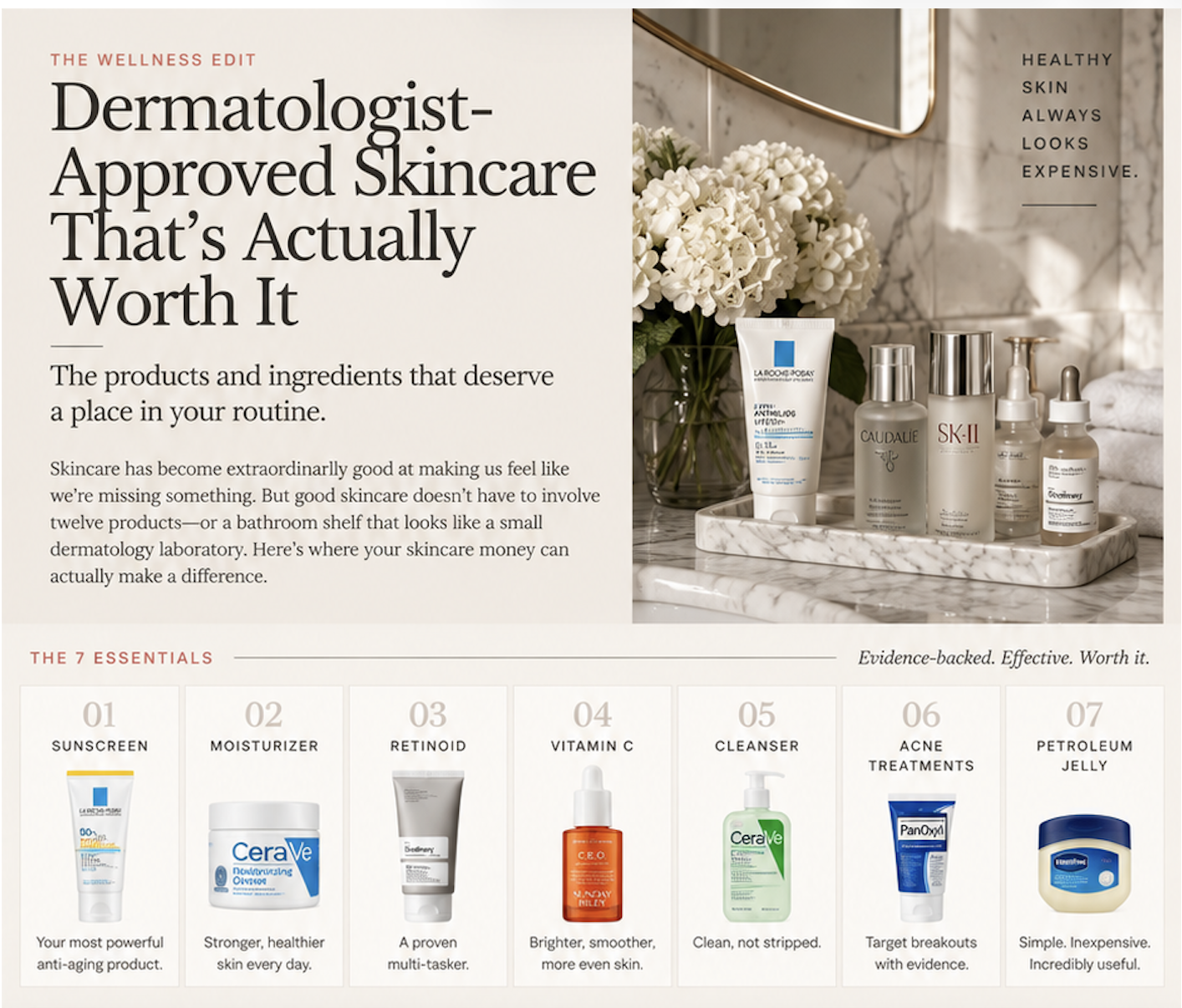
The products and ingredients that deserve a place in your routine.

Skincare has become extraordinarily good at making us feel like we're missing something.

There is always another serum. Another active ingredient. Another beautifully packaged cream promising glass skin, smaller-looking pores, fewer wrinkles, brighter skin, better texture, and possibly inner peace.

But good skincare doesn't have to involve twelve products—or a bathroom shelf that looks like a small dermatology laboratory.

In fact, dermatologists tend to come back to a much less exciting principle: protect your skin, support its barrier, and choose evidence-backed ingredients for the specific concerns you actually want to treat.

The American Academy of Dermatology recommends starting with sunscreen and moisturizer, calling them two of the most effective anti-aging products you can buy.

So before buying another viral serum, here's where your skincare money can actually make a difference.

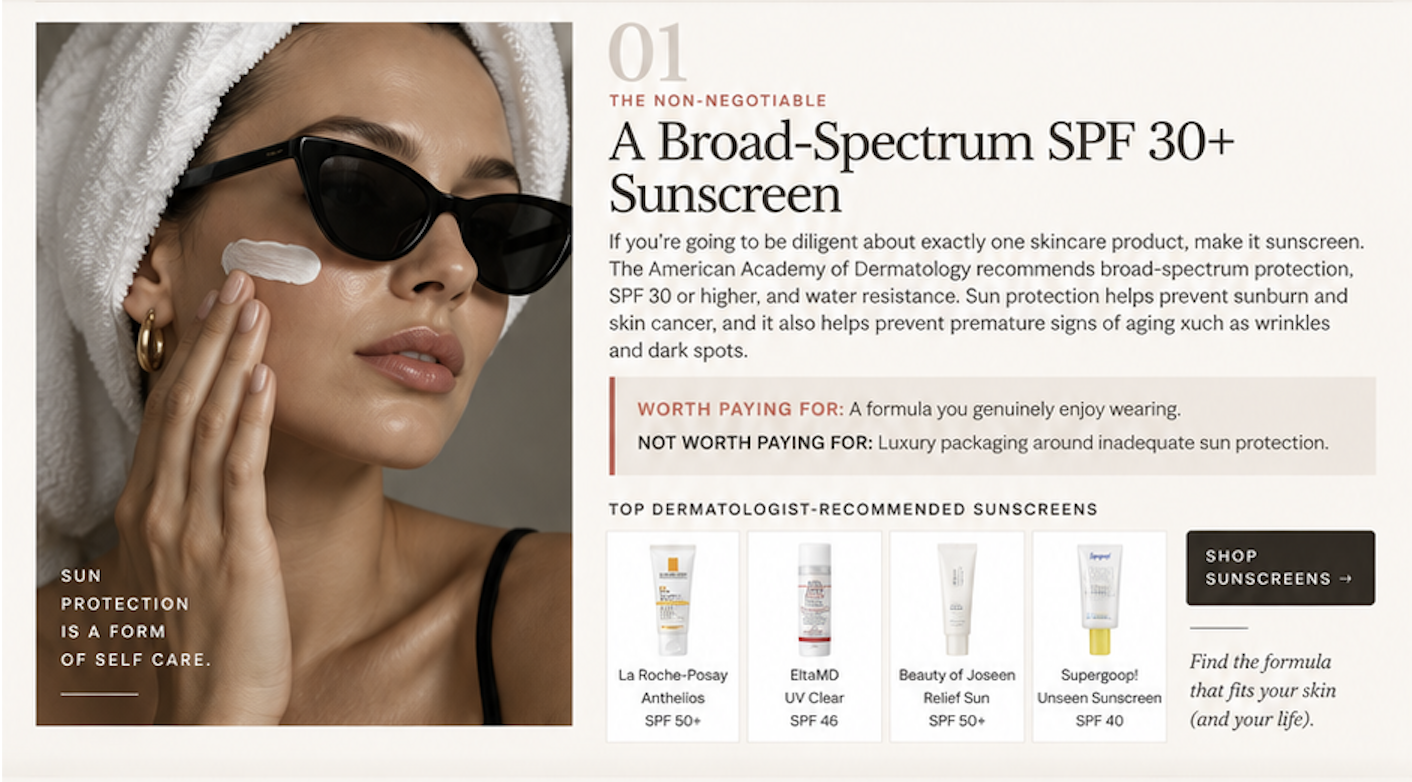
1. A Broad-Spectrum SPF 30+ Sunscreen

If you're going to be diligent about exactly one skincare product, make it sunscreen.

Not the $90 eye cream.

Not the overnight mask.

Sunscreen.

The American Academy of Dermatology recommends choosing sunscreen with broad-spectrum protection, SPF 30 or higher, and water resistance.

Sun protection helps prevent sunburn and skin cancer, but it also helps prevent premature signs of skin aging such as wrinkles and age spots.

And here's the important part: the best sunscreen isn't necessarily the most expensive one.

It's the one you will actually apply enough of and wear consistently.

If a lightweight Korean sunscreen makes you happy to put SPF on every morning, wonderful. If you prefer a drugstore formula, also wonderful. If your skin is sensitive, oily, dry, acne-prone, or you wear makeup every day, look for a texture formulated around those needs.

Worth paying for: A formula you genuinely enjoy wearing.

Not worth paying for: Luxury packaging around inadequate sun protection.

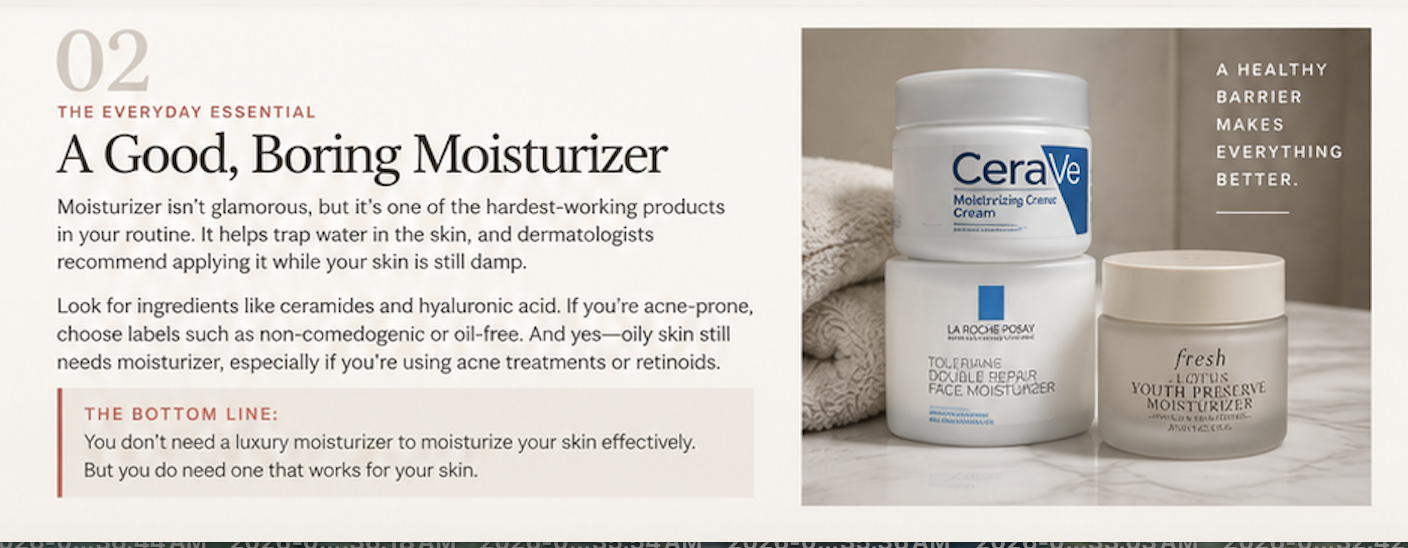
2. A Good, Boring Moisturizer

Moisturizer isn't glamorous.

Which is unfortunate, because it's one of the hardest-working products in your routine.

Moisturizers help trap water in the skin, and dermatologists recommend applying them while skin is still damp to help retain that moisture.

Ingredients such as ceramides and hyaluronic acid are commonly worth looking for in moisturizers, while fragrance may be irritating for some people with dry or sensitive skin.

And yes, oily and acne-prone skin can still need moisturizer. Acne treatments including benzoyl peroxide, salicylic acid and retinoids can be drying and irritating, and moisturizer can make those treatments easier for skin to tolerate.

If you're acne-prone, look for labels such as non-comedogenic, oil-free, or won't clog pores.

You absolutely can buy a luxurious moisturizer because you adore the texture and experience.

But you don't need a luxury moisturizer to moisturize your skin effectively.

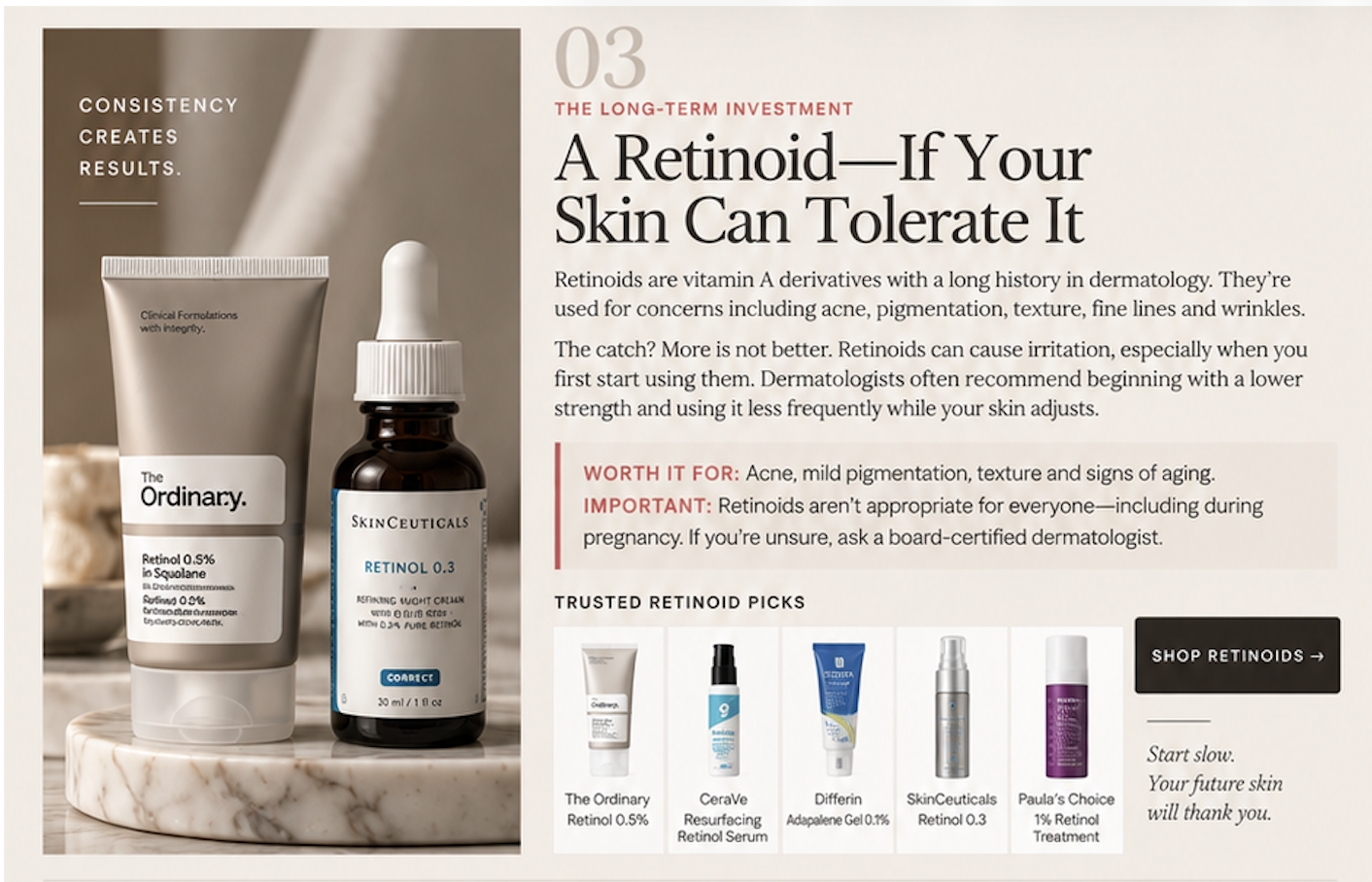
3. A Retinoid—If Your Skin Can Tolerate It

Of all the trendy ingredients that cycle through skincare, retinoids are very much not a trend.

Retinoids are vitamin A derivatives with a long history in dermatology. Depending on the formulation, they're used for concerns including acne, pigmentation, texture, fine lines and wrinkles.

Retinol is an over-the-counter type of retinoid, while other forms are available by prescription or, in the case of adapalene, in some over-the-counter acne treatments.

The catch?

More is not better.

Retinoids can cause irritation and dryness, particularly when you first begin using them. Dermatologists often recommend beginning with a less intense formulation and using it less frequently while your skin adjusts.

And don't introduce a retinoid at the same time as six other powerful actives and then wonder why your face has declared war on you.

Worth it for: acne, mild pigmentation irregularities, texture and signs of aging.

Important: Retinoids aren't appropriate for everyone—including during pregnancy—and certain skin conditions can make them a poor choice. If you're unsure, ask a board-certified dermatologist.

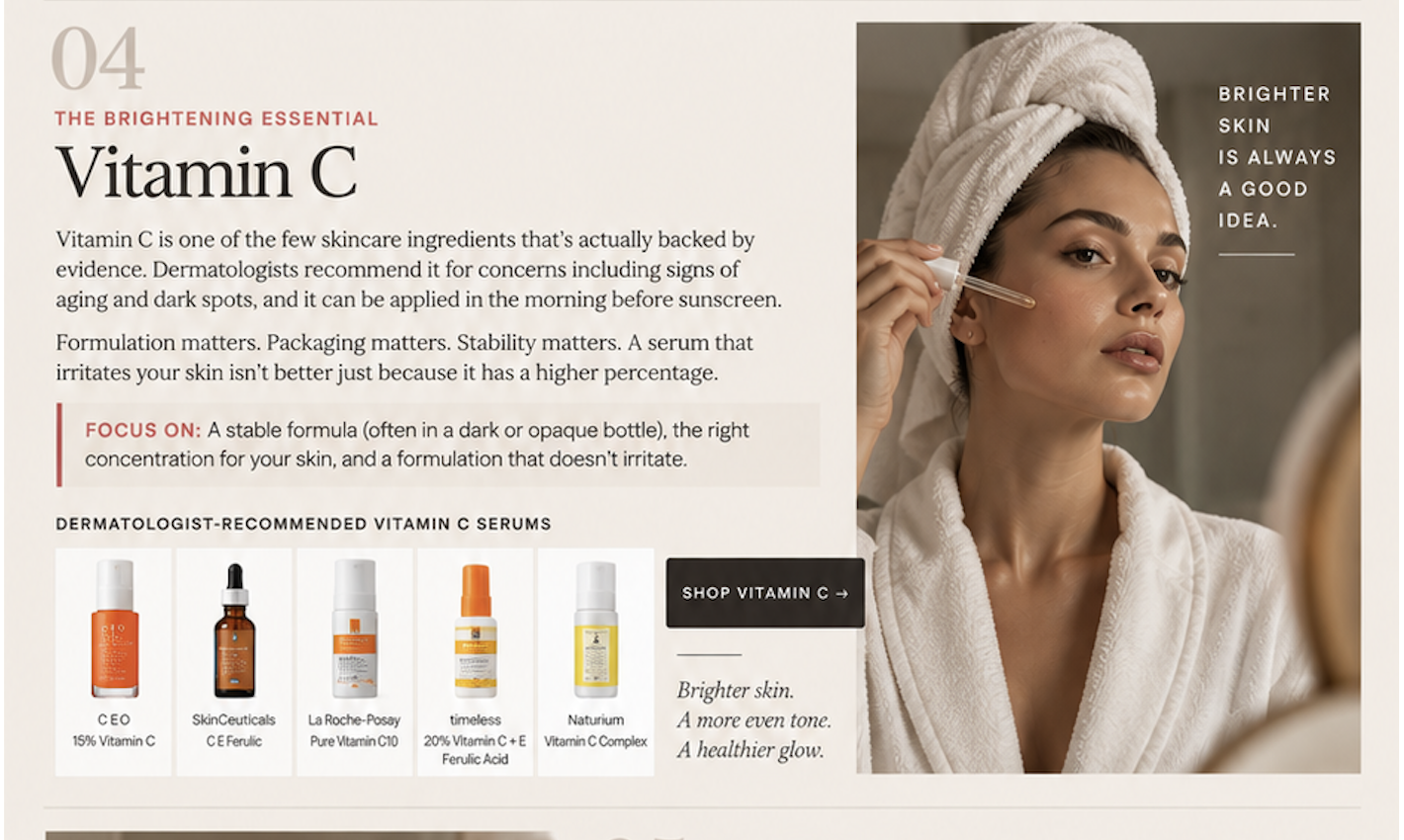
4. Vitamin C

Vitamin C is one of those skincare ingredients that managed to become trendy despite having actual evidence behind it.

Dermatologists recommend vitamin C for concerns including signs of skin aging and dark spots, and the AAD notes that it can be applied in the morning before sunscreen.

That doesn't mean every vitamin C serum is automatically excellent.

Formulation matters. Packaging matters. Stability matters. And a serum that irritates your skin isn't somehow better because it contains a higher percentage.

This is one category where I'd pay more attention to the formula and packaging than the prestige of the brand.

You aren't buying the prettiest bottle.

You're buying what's inside it.

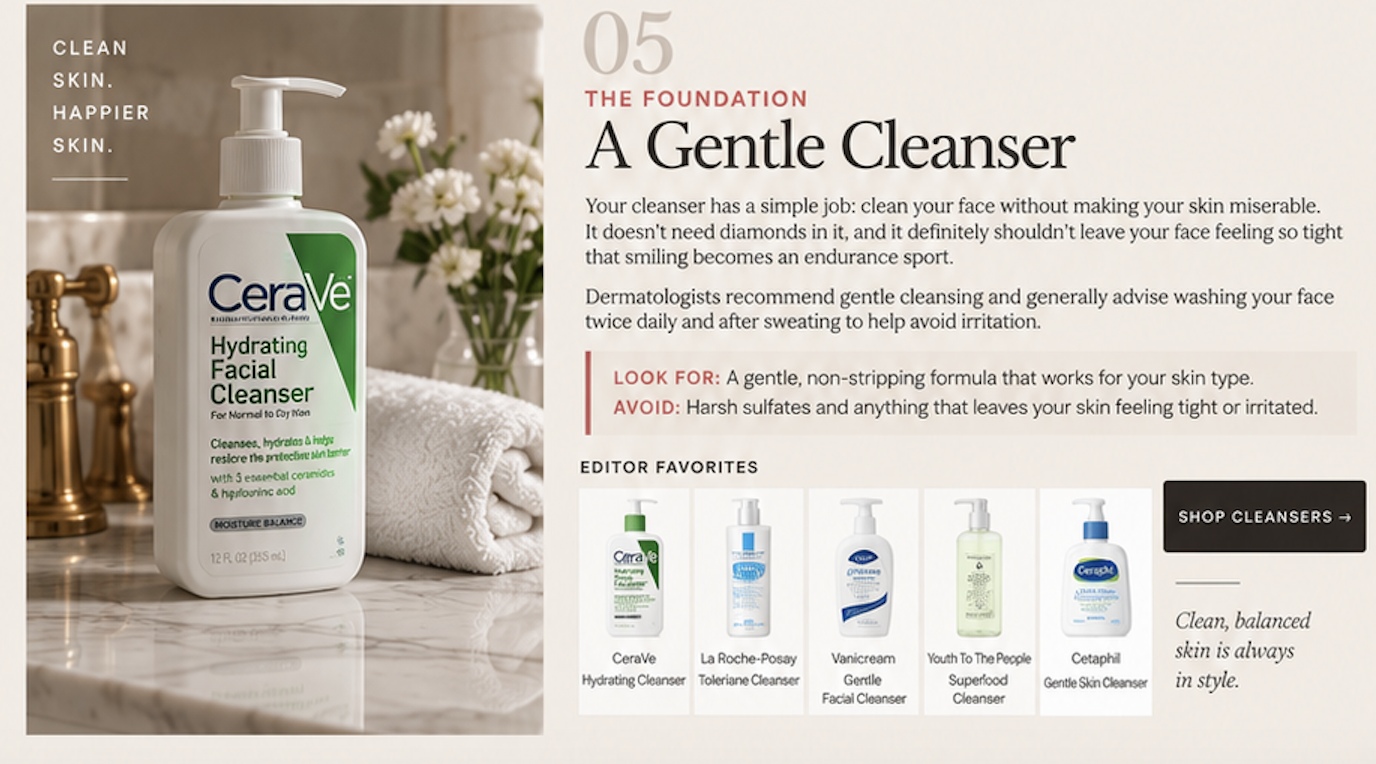
5. A Gentle Cleanser

Your cleanser has a fairly straightforward job:

Clean your face without making your skin miserable.

That's it.

It doesn't need diamonds in it.

It doesn't need to “detoxify” anything.

And it certainly doesn't need to leave your face feeling so tight that smiling becomes an endurance sport.

Dermatologists recommend gentle cleansing and generally advise limiting face washing to twice daily and after sweating to help avoid irritation.

If your skin feels stripped, painfully tight, itchy, or irritated after cleansing, that's not proof that the cleanser worked exceptionally well.

A cleanser is on your skin for such a short period of time that this is also one of the easiest places to save your money for products that stay on your skin.

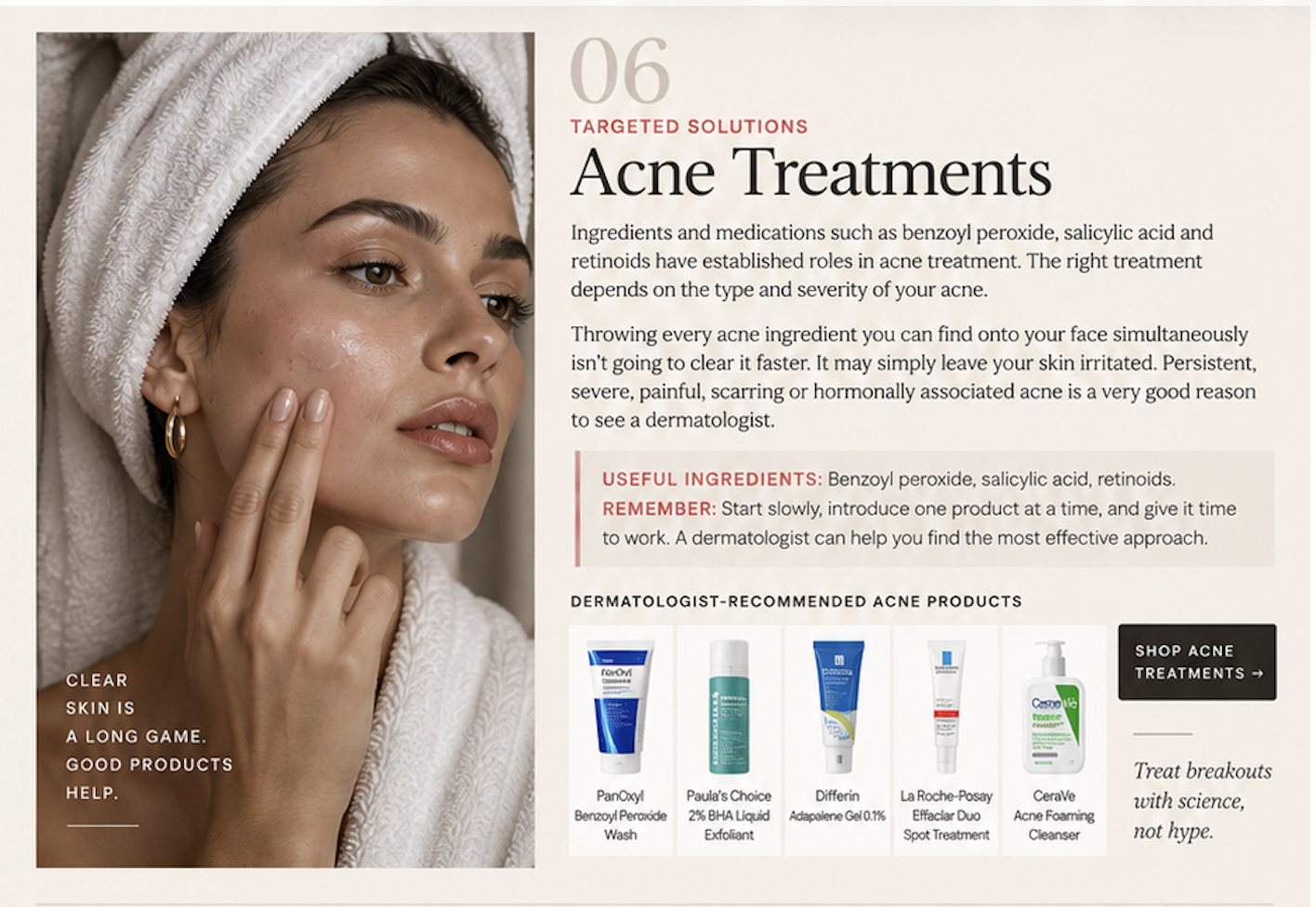
6. Targeted Acne Treatments

This is another area where evidence beats beautiful marketing.

Ingredients and medications such as benzoyl peroxide, salicylic acid and retinoids have established roles in acne treatment.

The right treatment depends on the type and severity of your acne, however.

Throwing every acne ingredient you can find onto your face simultaneously isn't necessarily going to clear it faster. It may simply leave your skin irritated.

And persistent, severe, painful, scarring or hormonally associated acne is a very good reason to see a dermatologist rather than continuing to buy increasingly aggressive products yourself.

Sometimes the product actually worth the money is the prescription.

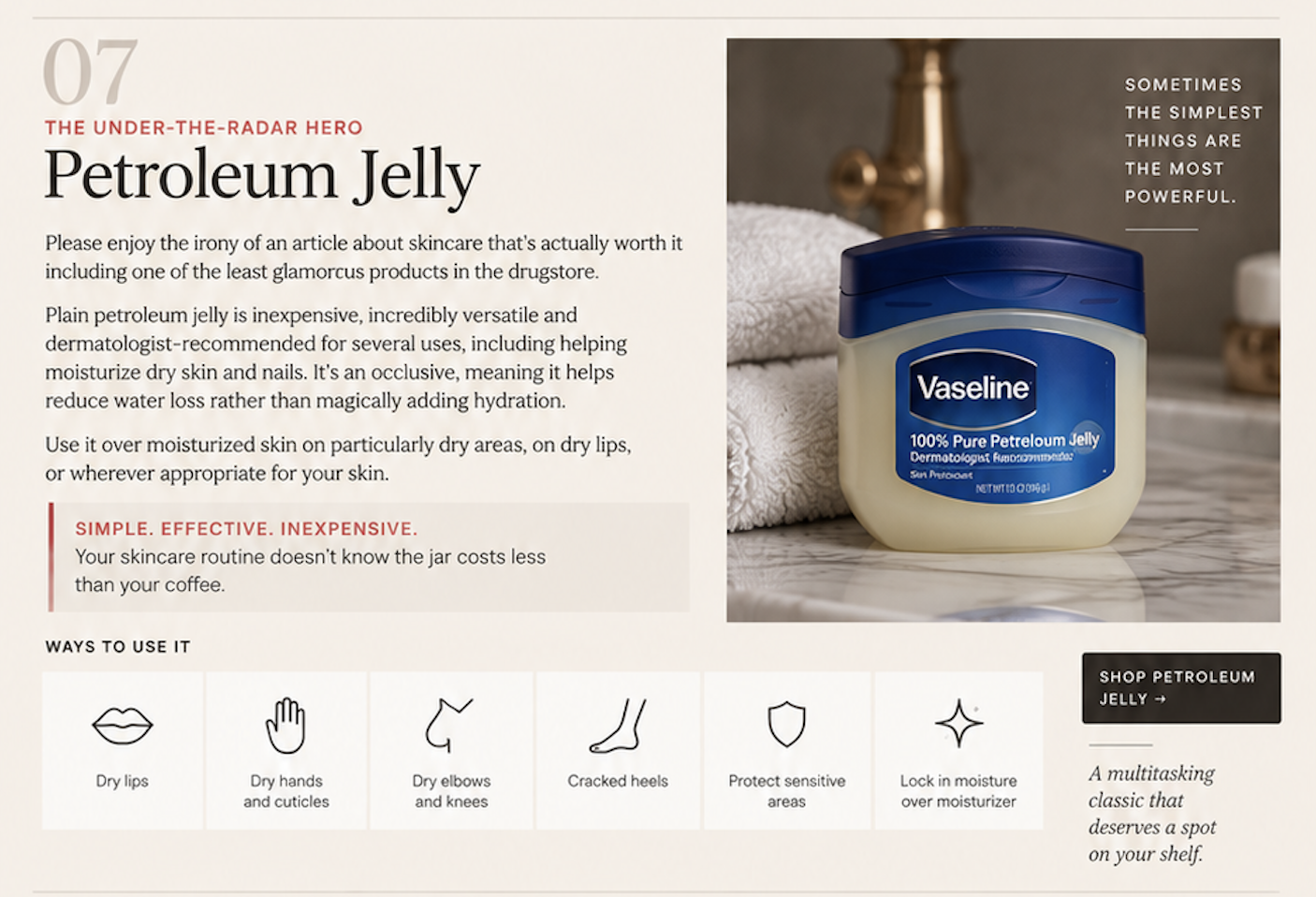
7. Petroleum Jelly

Please enjoy the irony of an article about skincare that's “actually worth it” including one of the least glamorous products in the drugstore.

Plain petroleum jelly is inexpensive, incredibly versatile and dermatologist-recommended for several uses, including helping moisturize dry skin and nails.

It's an occlusive, meaning it helps reduce water loss rather than magically adding hydration from nowhere.

Use it over moisturized skin on particularly dry areas, on dry lips, or wherever appropriate for your skin.

Your skincare routine does not know that the jar costs less than your coffee.

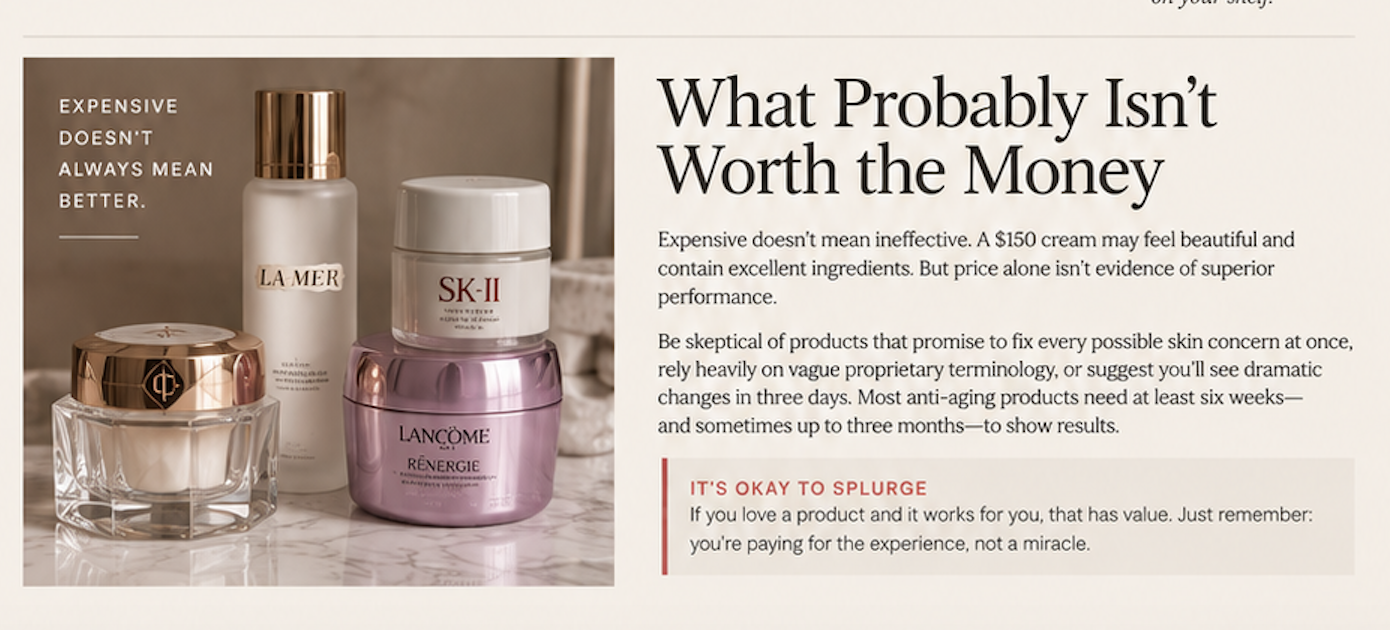
What Probably Isn't Worth the Money

This is where skincare becomes fun.

Because expensive doesn't mean ineffective.

A $150 cream may feel beautiful. It may contain excellent ingredients. You may love using it every night.

That experience has value if it's valuable to you.

But price alone isn't evidence of superior performance.

Be especially skeptical of products that promise to fix virtually every possible skin concern at once, rely heavily on vague proprietary terminology, or suggest you'll see dramatic structural changes from a cosmetic product in three days.

Skincare generally requires consistency. The AAD notes that while moisturizer can temporarily improve the appearance of fine lines relatively quickly, many anti-aging products need at least six weeks—and sometimes up to three months—to show results.

If the marketing sounds miraculous, the miracle may primarily be occurring in the marketing department.

You Probably Don't Need a 12-Step Routine

More skincare isn't automatically better skincare.

In fact, using too many products—particularly multiple anti-aging actives—can irritate the skin. Dermatologists recommend a basic order of gentle cleansing, treatment if needed, moisturizer and/or sunscreen, followed by makeup if desired.

That's refreshingly boring.

And boring can be excellent.

Start with the basics. Introduce targeted products because you have a reason to use them—not because your algorithm showed them to you seventeen times this week.

Then give them enough time to work.

Where to Spend—and Where to Save

Spend according to performance and your own priorities, not category prestige.

A sunscreen you love enough to wear every day? Worth it.

A well-formulated treatment targeting something that genuinely bothers you? Potentially worth it.

A moisturizer your sensitive skin tolerates beautifully? Absolutely.

A $95 cleanser that spends approximately 45 seconds on your face before disappearing down the drain?

We can probably discuss alternatives.

And remember that inexpensive skincare isn't inherently inferior. The AAD itself recommends budget-conscious basics such as gentle cleansing, moisturizing damp skin, sun protection, multipurpose products and even petroleum jelly.

The Bottom Line

The skincare products most worth buying aren't necessarily the ones with the longest ingredient lists or the most convincing before-and-after photographs.

They're the ones with a clear purpose, appropriate formulation, evidence behind the ingredients, and a realistic place in your routine.

Protect your skin from the sun.

Keep it moisturized.

Treat specific concerns with ingredients that actually have evidence behind them.

And remember: if your routine is working, you don't have to keep adding things to it just because the beauty industry invented another step.

Good skincare isn't about owning more products. It's about making the products you use actually earn their place on your shelf.